

The Isle of Man's registrable beneficial ownership threshold is now 25% or more, rather than more than 25%. The change was made by the Beneficial Ownership Act 2017 (Amendment) Order 2026, approved alongside the Beneficial Ownership Information Regulations 2026 at the May 2026 sitting of Tynwald. It is the change every summary leads with, and the least demanding of the three. The new definition attaches that percentage only to interests held through direct or indirect ownership of shares or voting rights. Where a person is a beneficial owner because they exercise, or are entitled to exercise, control through other means, the Isle of Man Financial Services Authority's April 2026 Guidance is explicit that no percentage threshold applies at all. And where no natural person meets the definition, information on the senior managing official must be submitted instead.
What actually changed
The Order's primary purpose is narrow: it amends the definition of "registrable beneficial owner" in the Beneficial Ownership Act 2017. The Department for Enterprise (Central Registry) is progressing the package with the Treasury to meet Financial Action Task Force standards, having consulted an industry working group from the trust and corporate services provider sector.
The old definition caught a beneficial owner who "owns or controls more than 25% of the beneficial ownership" of an entity to which the Act applies. The new one means "a natural person who — (a) Ultimately owns or controls 25% or more of a legal entity to which this Act applies, including through direct or indirect ownership of — (i) shares; or (ii) voting rights; or (b) exercises, or is entitled to exercise, control over the legal entity via other means, whether directly or indirectly".
| Before | After | What it means in practice |
|---|---|---|
| More than 25% of the beneficial ownership | 25% or more of the entity | Four equal quarters: four registrable owners |
| One percentage test for ownership or control | The percentage applies only to shares or voting rights | A test for ownership, not for control |
| Control read within that same test | A separate limb for control via other means | No threshold; shareholding is not the trigger |
| A section 20 statement where nobody qualified | That statement plus senior managing official particulars | "Nobody" no longer ends the exercise |
We work through registers entity by entity against the amended definition.
The change most summaries miss
The Guidance is blunt: "No percentage threshold is applicable where a person is a beneficial owner by virtue of exercising, or being entitled to exercise, or control through other means." That limb has no line to sit close to, so a shareholding-led review misses it.
Control via other means "includes any ability (whether formal or informal, legally enforceable or not) to direct, determine, influence or veto a decision relating to the management, activities, assets, governance, beneficiaries, distributions, or other affairs of the legal entity, including where such control is exercised through a legal arrangement (such as a trust, or any equivalent structure)". An understanding nobody could enforce counts, and so does a power only ever used to block.
The Guidance looks through the arrangement: the registrable beneficial owner "(i) is the natural person who ultimately exercises such ownership or control; and (ii) is not the legal arrangement or any legal person acting in a nominee, representative or fiduciary capacity." Naming the trustee company discharges nothing — the same look-through as enhanced due diligence on politically exposed persons.
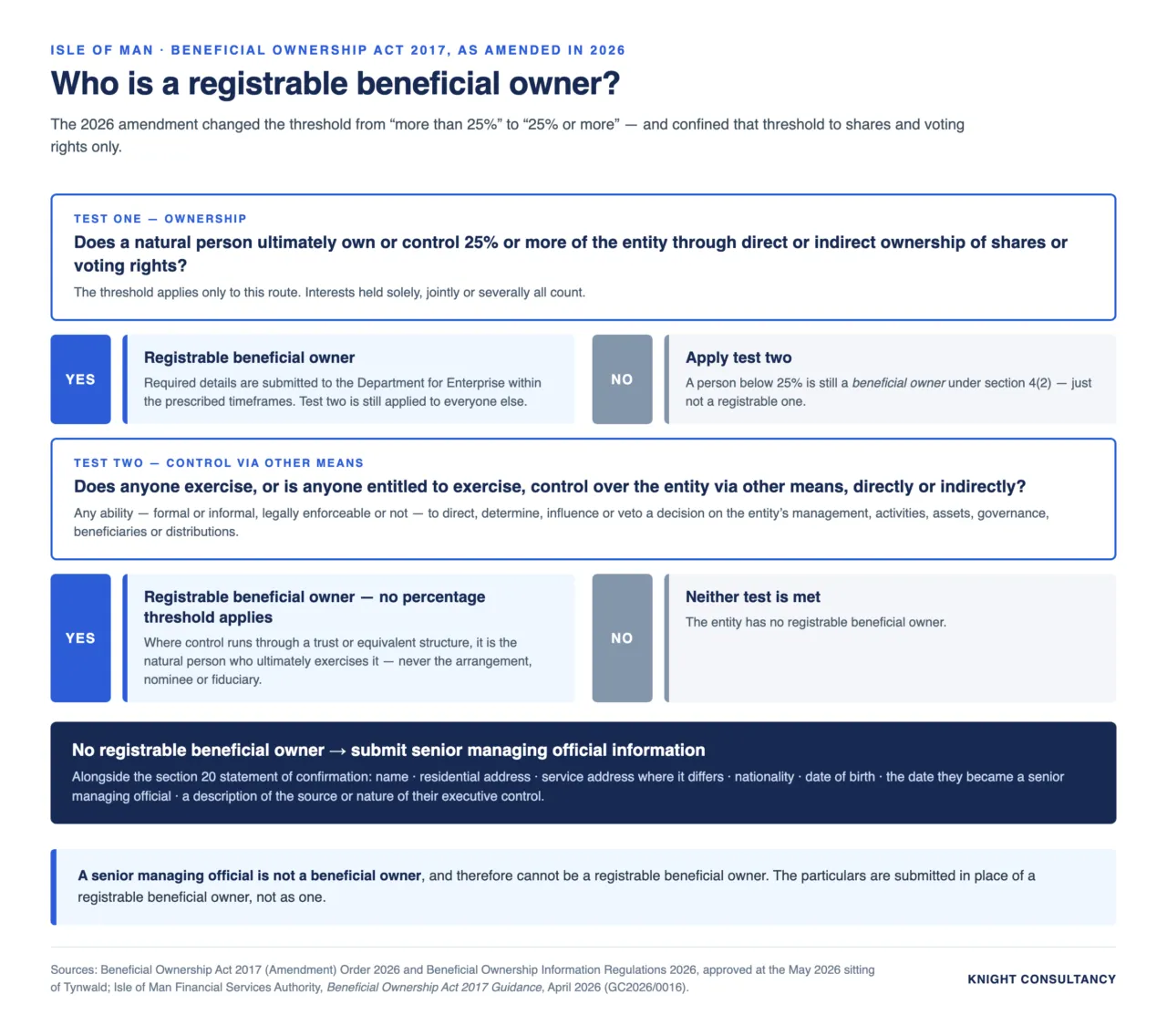
The test runs in order:
- Does a natural person ultimately own or control 25% or more through direct or indirect ownership of shares or voting rights? If so, they are registrable.
- If not, does anyone exercise, or is anyone entitled to exercise, control via other means, directly or indirectly? If so, they are registrable, with no threshold applied.
- If neither, senior managing official information must be submitted.
"Registrable" is narrower than "beneficial owner"
Conflating them produces a register entry the file underneath cannot support. Section 4(1) defines a beneficial owner as "a natural person who ultimately owns or controls a legal entity to which the Act applies, in whole or in part, through direct or indirect ownership or control of shares or voting rights or other ownership interest in that entity, or who exercises control via other means". Section 4(2) confirms the term applies whether an interest is held solely, jointly or severally, and "also includes individuals with an interest below the registrable threshold of 25%".
The population you identify is wider than the one you submit. The Guidance calls the definition "broad", seeking "to capture all individuals who hold any definable ownership interest through whatever means", and says "It is essential that all beneficial owners are identified, and their interest verified, at the outset". Control is read just as broadly, and whether a person holds such a right "may be a matter of fact and law, which must be determined in the case of each entity."
When there is no registrable beneficial owner
"Should there be no natural person meeting the definition of a registrable beneficial owner, information on the person(s) occupying the position of Senior Managing Official must be submitted to the Department." That person is not a beneficial owner and cannot be a registrable one. Regulation 7 of the Beneficial Ownership Information Regulations 2026 lets the Authority issue guidance on the term. Alongside the section 20 statement of confirmation, the nominated officer provides:
| Particular required | Note in practice |
|---|---|
| The individual's name | As verified on file |
| The individual's residential address | Not the registered office |
| A service address, where it differs from the residential address | Only where they differ |
| The individual's nationality | Record each one held |
| The individual's date of birth | Verified, not asserted |
| The date they became a senior managing official | Evidence the date |
| A description of the source or nature of executive control | Free text, and the most tested |
That last row must point at something real, such as a constitutional provision or a delegated authority, not a job title.

What this means for your CDD, not just your filings
Beneficial ownership and control in customer due diligence is dealt with at §3.4.5 of the AML/CFT Handbook (April 2026). A correct database entry does not evidence that you identified and verified beneficial ownership when you took the customer on: the register entry and the verified file are not the same artefact.
Firms interviewed during the Island's mutual evaluation may be asked to "Describe the different methods you use to confirm beneficial ownership information, if you choose not to utilise the beneficial ownership database as an obliged entity, how do you do it?" — one of the Authority's MONEYVAL Preparation frequently asked questions. Our note on the Island's MONEYVAL mutual evaluation covers how those interviews run. The wider definition also changes what your book looks like on paper, which belongs inside your AML business risk assessment.
What is still coming
A phased approach has been agreed for relevant persons to implement and adopt the changes, with the transitional provisions set out in Article 5 of the Amendment Order. The April 2026 Guidance, GC2026/0016 Version 1.0, replaces the guidance issued in 2024 and is more comprehensive.
Two pieces are still in progress. The Verification of Entity Registration Bill 2026 "seeks to amend and modernise laws relating to the registration of companies, partnerships, foundations, foreign companies and other legal entities", and on beneficial ownership it "lays out amendments to the timeframes regarding the submission of information". Separately, as reported in the Authority's AML Focus newsletter of May 2026, a consultation is open on a 'legitimate interest' access route, following a joint Isle of Man, Jersey and Guernsey commitment to enhance access with safeguards for privacy and personal safety. It proposes case-by-case applications to the Central Registry, an interest test of legitimate purpose and necessity, and disclosure limited to what is necessary and proportionate.

Common mistakes we see
Reviewing only the entities near the line. A 25% holder is the obvious catch; the control limb has no line.
Treating "no registrable beneficial owner" as a conclusion inherited from the last filing. It has to be reached again, and where it holds, senior managing official particulars follow.
Naming the wrong legal person. Where control runs through a trust, the registrable beneficial owner is the natural person behind it, not a nominee or fiduciary.
Filing accurately and verifying nothing. Section 4(2) reaches below the threshold, so a file documenting only the people you submitted is thin where it is tested.
Frequently asked questions
Does a person holding exactly 25% now have to be registered?
Yes, where the interest is held through shares or voting rights, directly or indirectly: the Guidance states the threshold "was reduced from more than 25% to 25% or more of the total beneficial ownership".
Can someone with no shares be a registrable beneficial owner?
They can. The second limb covers a natural person who exercises, or is entitled to exercise, control via other means, with no percentage threshold. That ability may be formal or informal, enforceable or not.
Do we still have to record beneficial owners below 25%?
Yes. Section 4(2) confirms that "beneficial owner" includes individuals below the registrable threshold, and all of them must be identified and their interests verified. What changes at 25% is what you submit, not what you must know.
What do we submit if nobody meets the definition?
The section 20 statement of confirmation, plus the senior managing official's name, residential address, service address where it differs, nationality, date of birth, the date they took the position, and a description of the source or nature of their executive control.
We review beneficial ownership records against the amended definition and the evidence behind each entry.
If your review starts and ends with a shareholder list, it answers the half of the definition that changed by one word and ignores the half that no longer has a threshold at all.